Car Rentals & International Permits
Driving in Thailand is the ultimate liberation: an opportunity to swap crowded tour buses for the rhythm of the local road. From the neon-lit intersections of Bangkok to the salt-sprayed coastal highways of Phuket, mastering the logistics of car rentals and international permits is the first step toward a true Thai expedition. Whether you are a backpacker chasing mountain roads in Mae Hong Son, a family wanting the flexibility of your own air-conditioned SUV, or a remote worker planning a slow lap of the country on a Destination Thailand Visa, this guide has the real-world detail you need.
The Quick View:
- Essential Documents: You must carry both your original national driver’s license and a valid International Driving Permit (IDP) issued under the 1949 or 1968 convention.
- Average Costs: Economy car rentals typically range from 800 THB to 1,200 THB per day, depending on the season and location.
- Driving Side: Thailand drives on the left. Steering wheels are positioned on the right side of the vehicle.
- Insurance Reality: Standard rental rates usually include basic CDW, but a “No Excess” top-up is highly recommended to cover the 5,000 THB to 10,000 THB deductible.
- Minimum Age: Most agencies require drivers to be at least 21 years old. Luxury and specialist 4WD rentals often set the minimum at 25.
- Fuel: Rental cars typically run on Gasohol 91 or 95. Petrol prices hover around 35 to 45 THB per litre. Always check the sticker inside the fuel flap before filling.

Compare every route to Thailand:
sleeper bus, train, or ferry, all
priced and reviewed in one place.
No guessing which operator is safe.
International Driving Permits:
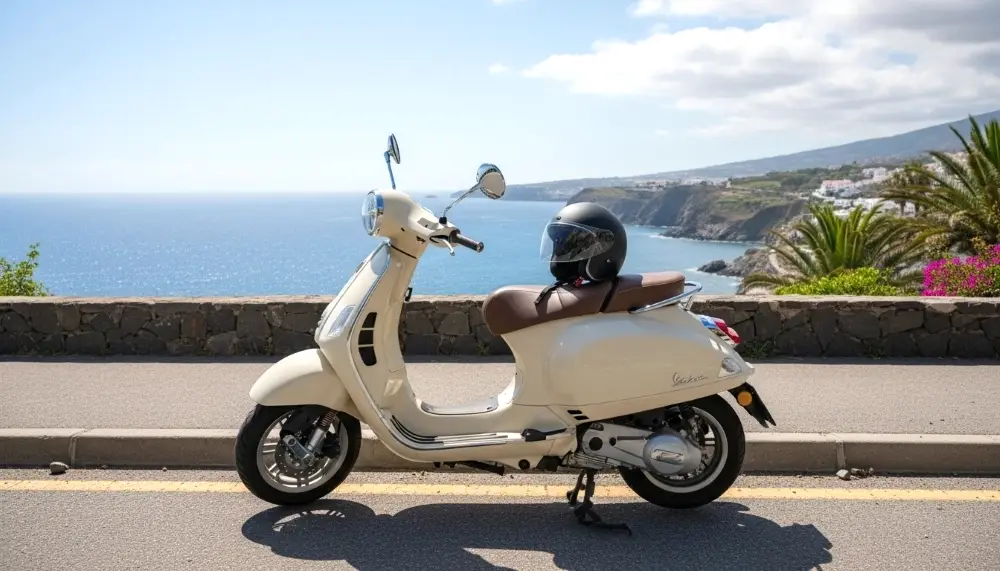
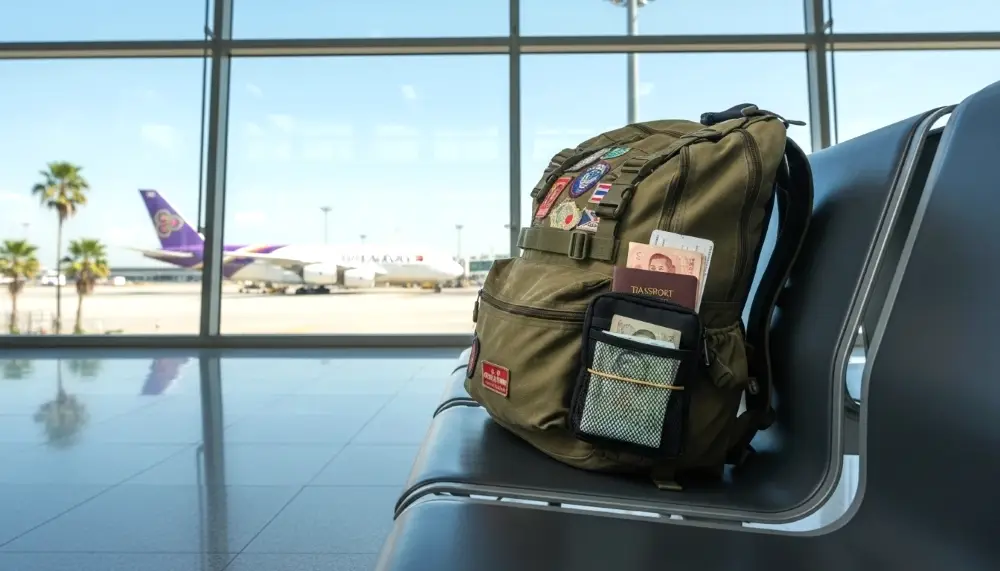
To drive legally in Thailand as a tourist, you must possess a valid International Driving Permit (IDP) alongside your original home-country license. While some rental agencies may overlook this during the booking process, Thai Traffic Police and insurance providers require both documents during checkpoints or in the event of an accident to validate coverage.
Navigating a police checkpoint in Pathum Wan or Thong Lor without an IDP often results in an immediate fine of 500 THB to 1,000 THB. More critically, driving without a valid IDP nullifies your travel insurance and the rental car’s collision damage waiver. This is not a technicality to gamble with.
The Department of Land Transport (DLT) recognises permits from both the 1949 and 1968 Geneva Conventions. If the home license is not in English, an official translation stamped by the relevant embassy is required. For those on long-term stays, such as the Destination Thailand Visa (DTV), the IDP remains valid for the first 90 days of each entry period, after which a local Thai Driver’s License must be obtained at a DLT office.
Where to get your IDP: In the UK, apply through the Post Office or the RAC. In the US, apply through the AAA or AATA. In Australia, apply via NRMA or your state motoring club. The permit is typically issued on the same day, costs very little, and is valid for one year. Apply before you fly.

From classic Thailand highlights to
hidden-gem private tours. Cancel
free up to a day before your
start time if plans change.
Car Rental Comparison:
Selecting the right vehicle depends on the terrain. A compact car is ideal for the tight sois of Chiang Mai, while a 4WD is essential for the rugged hills of Nan or the unpaved tracks leading to Rai Leh. Consider your group size, luggage volume, and the nature of the roads you plan to tackle before committing.
| Vehicle Category | Average Daily Rate (THB) | Best Use Case | Recommended Models |
|---|---|---|---|
| Economy / Mini | 750 to 1,100 | City hopping and short coastal drives | Toyota Yaris, Honda Brio |
| Compact / Sedan | 1,200 to 1,800 | Inter-city travel (Bangkok to Hua Hin) | Honda City, Toyota Vios |
| SUV / 4WD | 2,200 to 3,500 | Mountain loops and jungle expeditions | Toyota Fortuner, Isuzu MU-X |
| MPV / People Carrier | 1,800 to 2,800 | Family trips and airport runs with luggage | Toyota Innova, Mitsubishi Xpander |
| Pickup Truck | 1,500 to 2,500 | Rural provinces, agriculture-zone roads | Toyota Hilux Revo, Ford Ranger |
The Rental Process:
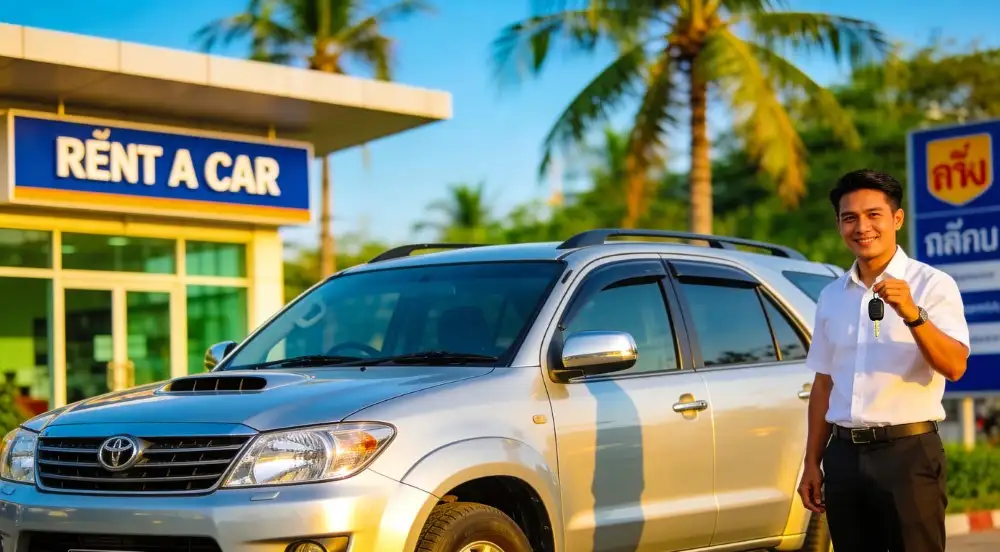
Renting a car in Thailand requires a passport, a valid driver’s license with an IDP, and a credit card for the security deposit. Most reputable agencies require the driver to be at least 21 years old, though some luxury or specialised 4WD rentals may raise this age limit to 25.
When collecting a vehicle at Suvarnabhumi Airport (BKK) or Phuket International (HKT), the “Plus Plus” system, referring to the 7% VAT and potential 10% service fees, is often already baked into the quoted price from international brands like Avis or Hertz. However, local boutique agencies may add these at the final stage. Always ask for a fully itemised quote before signing.
For group and family arrivals needing an immediate and stress-free transfer from the airport before the rental begins, Welcome Pickups offers pre-booked, fixed-price vehicles with English-speaking drivers. It removes the chaos of negotiating a taxi rank with multiple bags and tired children in tow.
Insight: Do not rent the cheapest “no-name” bike or car found on a Facebook group or a roadside shack in Samui. These often lack compulsory third-party insurance (Por Ror Bor). Stick to established local firms like Thai Rent A Car or Chic Car Rent to ensure the vehicle is legally registered and insured. International brands give you a paper trail; budget roadside operators often do not.
Booking ahead: During Songkran (Thai New Year, April) and the Christmas and New Year period, rental stock in popular destinations like Chiang Mai, Phuket, and Pai runs out weeks in advance. Use 12GO to compare and lock in your vehicle hire alongside bus or train tickets for any intercity legs of the journey.
Understanding Insurance:
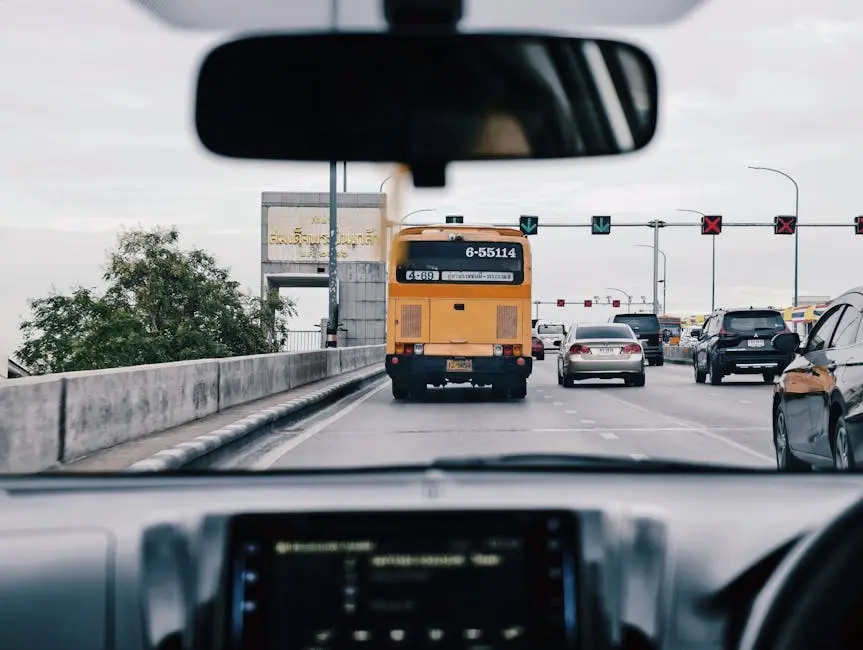
Thai car rental insurance can feel confusing, but the framework is straightforward once you understand the three layers. The first is Por Ror Bor, the compulsory government third-party liability insurance that all registered vehicles must carry. This covers bodily injury to third parties but nothing for your vehicle or your own medical costs.
The second layer is the Collision Damage Waiver (CDW), typically included in the standard rental rate. This limits your financial exposure in the event of damage to the rental vehicle, but nearly always comes with an excess, or deductible, of between 5,000 THB and 10,000 THB. If the windscreen cracks on a mountain road in Chiang Rai, that bill lands with you.
The third layer is the optional “No Excess” top-up or Super CDW. Paying an extra 200 to 400 THB per day eliminates the deductible entirely. For families, long-distance drivers, or anyone tackling rural terrain, this is the sensible choice.
Travel Insurance: Your credit card or annual travel policy may include rental car excess cover. Check the small print before automatically buying the rental agency’s top-up; you may already be covered. For long-stay residents and remote workers, SafetyWing’s nomad medical and travel insurance integrates well with extended Thailand trips, covering emergency evacuation and hospitalisation at a flat monthly rate.

From boutique guesthouses to five-star
resorts, Agoda has Thailand covered.
Strong Asia inventory means deeper
discounts than you’d find elsewhere.
Road Customs:
Thai road culture is governed by “Kreng Jai” (consideration) and a fluid interpretation of right-of-way. While official laws exist, the unwritten rule is that the larger vehicle typically takes precedence. Flash of high beams does not mean “go ahead” as it does in the West; it signifies “I am coming through, do not pull out.”
Parking Etiquette: White and red stripes on a curb mean “No Parking.” Yellow and white stripes indicate a short-term loading zone. Ignoring these in areas like Nimmanhemin in Chiang Mai will result in a wheel clamp and a trip to the local police station to pay a fine, typically 500 THB to 1,500 THB.
Toll Roads: Bangkok’s expressway network requires payment at toll booths. Most booths accept cash (10 to 75 THB depending on the route), but the EasyPass electronic tag system is available if you are renting for an extended period and plan to use the capital’s elevated network regularly. Ask your rental agency whether the vehicle has an EasyPass unit fitted.
Speed Limits: The national motorway limit is 120 km/h. On standard highways it is 90 km/h. In urban areas it drops to 60 km/h. Speed cameras and traffic police are common at provincial boundaries and on the approach to major towns. Fines are payable at the nearest police station.
The “Plus Plus” Reality: When fuelling up at PTT or Shell stations, the price on the pump is final. There is no tipping culture at petrol stations, though attendants appreciate a simple “Khop Khun Ka/Krap.”

Book Thailand day trips, attractions,
and activities in one place. Check
real reviews and lock in your spot
before the popular slots go.
Seasonal Driving Conditions:
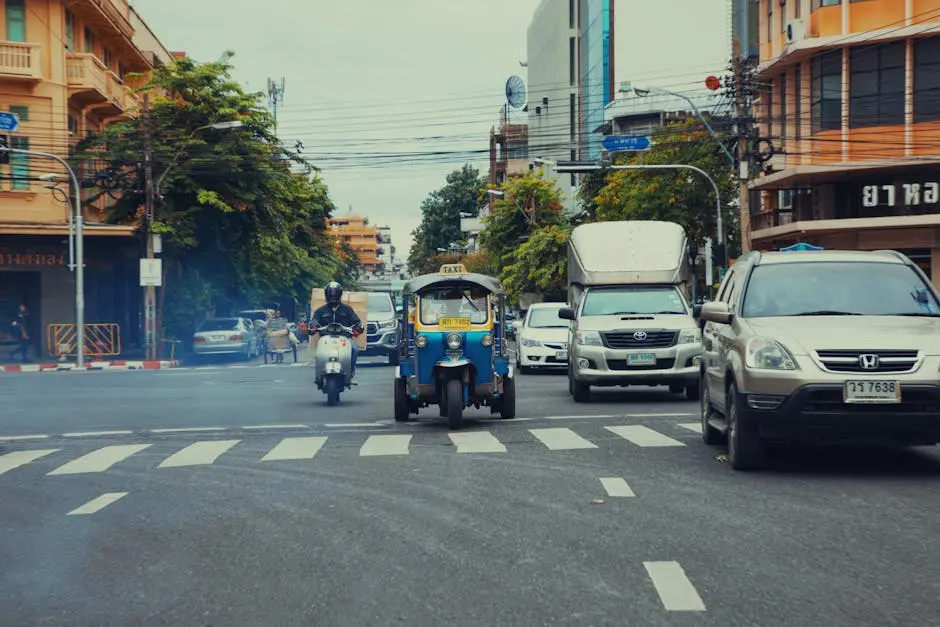
Thailand’s driving conditions change dramatically with the seasons, and understanding these cycles can save you from a genuinely dangerous situation.
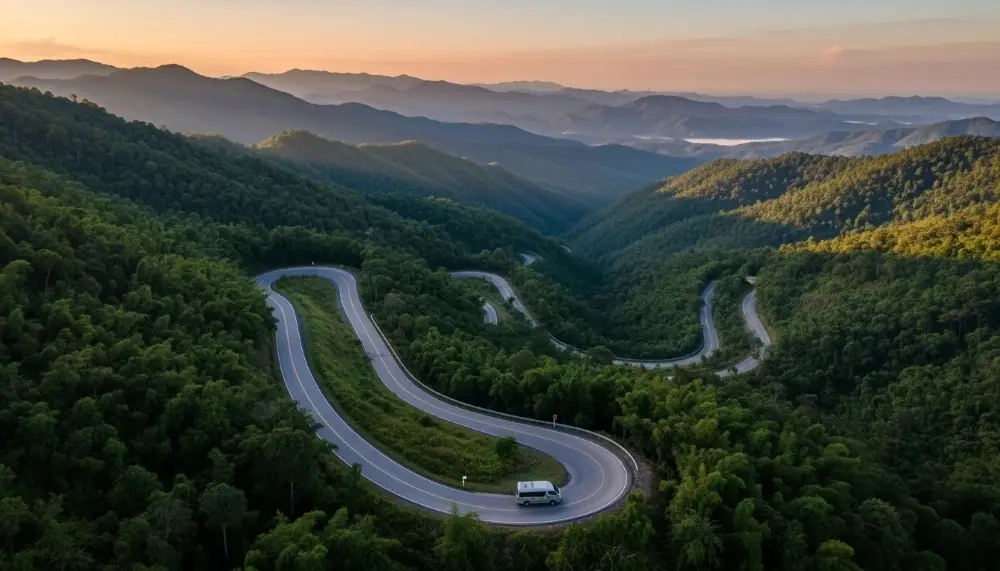
Cool Season (November to February): This is the ideal window for road trips. Temperatures are pleasant, visibility is excellent, and mountain passes in the north are at their most scenic. Roads remain dry, and the only hazard worth noting is morning fog on high-altitude routes above Doi Inthanon or along the Nan province loop.
Hot Season (March to May): Temperatures regularly exceed 38 degrees Celsius across the central and northern plains. Long daytime driving stints are tiring. Ensure the rental vehicle’s air conditioning is functioning before leaving the lot. Keep water in the car, and plan to drive early and stop during peak afternoon heat.
Wet Season (June to October): The monsoon brings flooding on low-lying roads, landslides on mountain passes, and dramatically reduced visibility during heavy downpours. Roads in the deep south (Pattani, Narathiwat) and the Kanchanaburi border areas can become impassable during peak rain events. Check Google Maps for real-time flood closures. If you are renting a standard sedan and the forecast shows sustained heavy rain, consider upgrading to a higher-clearance SUV, even for a few extra days.
For the Gulf Coast (Koh Samui, Koh Phangan), the wet season is reversed, peaking from October to December. Plan your island road trips accordingly.
One-Way Rentals and Cross-Province Driving:
One of the great freedoms of a Thai road trip is picking up a car in Bangkok and dropping it in Chiang Mai, or collecting in Phuket and returning in Krabi. Most major agencies offer one-way rentals between their branch locations, but the drop-off fee (typically 1,500 THB to 3,000 THB) should be factored into your budget from the start.
Budget-conscious travellers should compare whether a one-way rental or a bus ticket on 12GO makes more financial sense for a point-to-point journey. On the Bangkok to Chiang Mai corridor, a sleeper train booked via 12GO is often the more comfortable and economical choice, with the road trip better suited to the scenic return via Lampang and Sukhothai.
Cross-Border Note: Taking a Thai rental vehicle into a neighbouring country (Laos, Cambodia, Myanmar, or Malaysia) requires prior written permission from the rental company. Most domestic-grade agencies prohibit it outright. If a border crossing is part of your itinerary, discuss this explicitly before booking. Companies specialising in regional overlanding, such as Drive Thailand, can arrange the correct documentation and insurance endorsements.
Accommodation along the route: For long-distance drives, Agoda and Booking.com both allow last-minute bookings at roadside guesthouses, provincial hotels, and boutique resorts along every major Thai highway corridor. Filter by “free cancellation” when your arrival time is weather-dependent.

Skip the airport kiosk queue in Thailand.
Airalo eSIMs are pre-loaded before
you fly and ready the instant you
connect to the local network.
Pro Tips For Stress-Free Travel:

To navigate the Kingdom with precision, your digital arsenal should include:
Payments: While cash (THB) is king in rural areas, most petrol stations and shopping centres accept credit cards or PromptPay QR codes.
Navigation: Google Maps is highly accurate for Thailand, including lane guidance for complex Bangkok flyovers. Download your route offline before entering areas with patchy signal, particularly in Nan, Mae Hong Son, and the Kaeng Krachan National Park region.
Rideshare: Download Grab and Bolt. If you decide the traffic in Yaowarat (Chinatown) is too intense, park the rental in a managed lot and use these for short bursts. Note that both apps require SMS verification, which means you need active mobile data from the moment you land. Activate your Airalo, Yesim, or Saily eSIM data plan before departure so the network verification codes arrive instantly at the baggage carousel, not hours later.
Connectivity: Ensure a stable connection via Yesim or a local AIS/True SIM. Using a NordVPN is strongly advised when accessing banking apps or your employer’s systems over public cafe Wi-Fi in places like Nimmanhemin or Banglamung. A VPN also protects your data at hotel and resort networks, which are notoriously unsecured.
Flight Disruptions: If a delayed domestic connection (Bangkok Airways, Nok Air) forces a last-minute scramble at the rental desk, AirHelp can pursue compensation on your behalf for qualifying EU-regulated flights or codeshares, taking the administration burden off you while you deal with the logistics on the ground.
Day Trips Without the Car: There will be days when you want to park up and join a guided excursion, particularly around Chiang Mai (elephant sanctuaries, cooking classes), Kanchanaburi (Death Railway and Erawan Falls), or Krabi (island-hopping by longtail). Get Your Guide and Klook both offer same-day and advance bookings for hundreds of vetted experiences across Thailand, with instant mobile confirmation.

Stay online in Thailand without the
daily data limits of tourist SIMs.
Yesim’s eSIM offers unlimited 5G
from around $10 for the whole trip.
Driving in Bangkok:
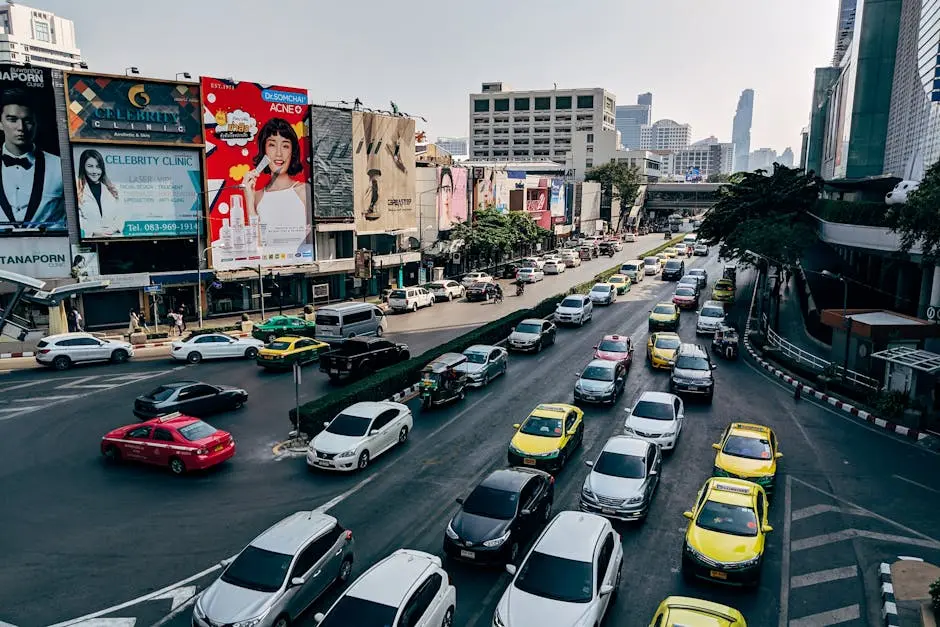
A word of honest advice: driving in central Bangkok is entirely optional, and for most visitors, entirely avoidable. The BTS Skytrain, MRT underground, and the Chao Phraya Express Boat network cover the majority of tourist and business zones with extraordinary efficiency. Add Grab to the mix and you will rarely need a rental car within the city itself.
That said, having a car parked at your accommodation on the outskirts of Bangkok, such as in Bang Na, Rama II, or the Laksi area, is genuinely useful for day trips to Ayutthaya, Amphawa Floating Market, or Bang Pa-In Royal Palace. Use the expressway (tag or cash toll) to avoid the surface-level traffic, and time your return to avoid the 5pm to 8pm gridlock heading back into the city centre.
The U-turn system is the single biggest adjustment for foreign drivers. Thai urban roads frequently prohibit left turns (the near-side turn, equivalent to a right turn in right-hand-drive countries) and instead funnel traffic through designated U-turn bays several hundred metres ahead. Google Maps accounts for this and will route you correctly. Trust the GPS and resist the urge to turn where instinct suggests.
Beyond the Holiday:
For those transitioning from a holiday to a lifestyle, Thailand offers several pathways. The Destination Thailand Visa (DTV) is the premier choice for remote workers in 2026, allowing for 180-day stays.
If you are relocating permanently, purchasing your own vehicle makes considerably more financial sense than long-term rental. The second-hand car market in Thailand is deep and well-organised. Platforms like Kaidee and Taladrod list thousands of vehicles at all price points. When buying, ensure the “Blue Book” (Lem Tabian Rot, the vehicle registration document) is transferred correctly at the DLT office. The seller’s name on the Blue Book must match their ID card, and the transfer requires both parties to be present. Buying privately without completing the transfer is a risk: you will not legally own the vehicle.
Annual road tax (Phor Ror Bor renewal and vehicle tax sticker) is processed at the DLT or at certain petrol stations, and requires a valid vehicle inspection (Sor Ror Bor) for cars over seven years old. Budget around 1,000 to 3,000 THB per year depending on engine size.
If moving permanently with pets, ensure you contact the Suvarnabhumi Animal Quarantine Station at least 30 days in advance. Long-term residents should also look into the Expat community groups on Facebook specific to their province, as local knowledge on mechanics, reliable second-hand dealers, and DLT appointment tips is invaluable.
Confidence Booster:
To build your confidence and ensure a safe journey, keep these logistical realities in mind:
- Bilingual Infrastructure: Major highways and regional arteries are well-maintained, and signage is almost always bilingual, featuring both Thai and English script. You will rarely feel lost on a numbered national highway.
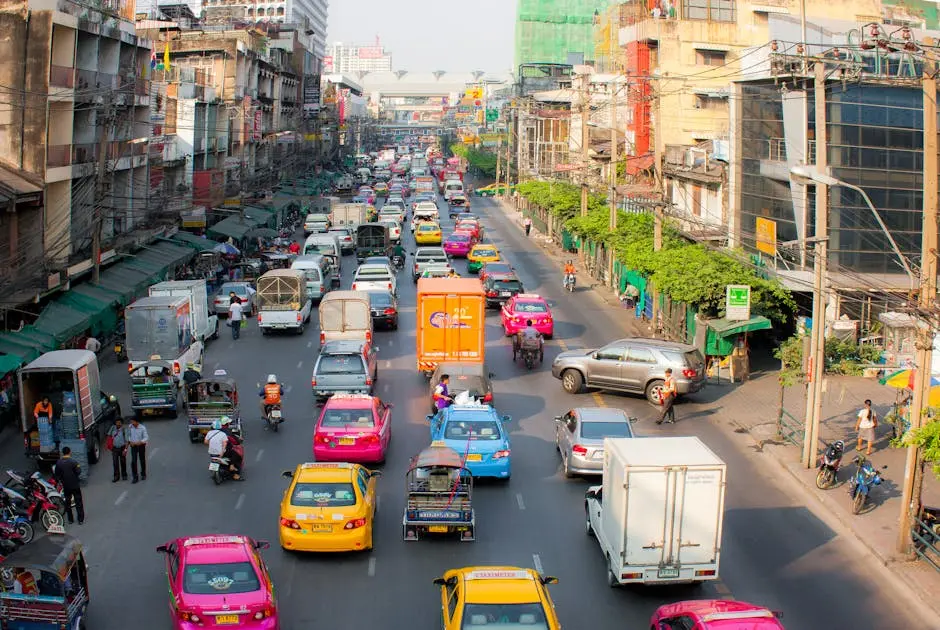
- The Bangkok Learning Curve: The capital’s traffic is legendary for its density and complex elevated interchanges. If the organised chaos of Bangkok feels overwhelming, consider starting your driving journey in a quieter province like Kanchanaburi or Rayong. These areas provide the perfect environment to acclimatise to the left-hand side of the road without the high-pressure environment of the city centre.
- The Flow of Traffic: While the rules of the road are standard, the “flow” is unique. You will share the tarmac with everything from long-haul trucks to agile motorbike taxis. Staying predictable and maintaining a steady pace is often more important than strictly following every minor technicality.
- Motorbikes at Junctions: Thailand has an extraordinarily high motorbike density. At red lights, bikes filter to the front. Give them space when the lights change. A motorcycle appearing from your blind spot at a junction is the single most common cause of tourist accidents. Check twice before crossing any intersection.
- Digital Navigation: Relying on updated GPS data is essential for navigating the multi-layered road systems in urban hubs. Ensure you have a local SIM card with nationwide coverage to keep your maps active, whether you are in the heart of the city or on a remote mountain pass in the far north.
Frequently Asked Questions:
Can I drive in Thailand with a UK or US license?
Only if it is accompanied by a valid International Driving Permit. Thailand is not a member of the ASEAN driving agreement that allows neighbours like Malaysia or Singapore to use their national licenses alone. You must carry both your original license and the IDP at all times while driving. Presenting one without the other at a checkpoint or following an accident is treated as though you hold no valid documentation.
What is the legal blood alcohol limit in Thailand?
The limit is 0.5mg per litre of blood. For drivers with less than five years of experience, the limit is stricter at 0.2mg. Penalties for drunk driving involve immediate court appearances, fines up to 20,000 THB, and potential deportation. During major festivals such as Songkran and New Year, police checkpoints multiply significantly, and enforcement is thorough. Never drink and drive in Thailand.
How much does petrol cost in Thailand?
Prices fluctuate with global oil markets but generally hover around 35 to 45 THB per litre for Gasohol 95. Diesel is cheaper, typically in the 30 to 38 THB per litre range. Most rental cars specify Gasohol 91 or 95; always check the sticker inside the fuel flap before filling. PTT, Shell, Esso, and Bangchak stations are all reliable and widespread along national highways.
Is it safe to drive at night in Thailand?
Night driving is generally discouraged on rural or mountainous roads. Unlit vehicles, roaming livestock, and heavy long-haul trucks make nighttime navigation significantly higher risk than daytime driving. On well-lit intercity highways between major towns (Bangkok to Hua Hin, or Chiang Mai to Lampang), night driving is manageable but fatigue remains a real concern on long stretches.
What should I do in a car accident?
Do not move the vehicle unless instructed by police or unless it is a hazard to other traffic. Call the Tourist Police (1155) or your rental agency’s emergency line immediately. Photograph all damage, positions of vehicles, and any visible injuries before anything is moved. Ensure you have your passport, driver’s license, and IDP ready for the attending officers. Do not accept fault or sign anything in Thai without understanding its full content.
How do I get an International Driving Permit before travelling to Thailand?
In the UK, apply through the Post Office or the RAC. In the US, apply via the AAA or AATA. In Australia, apply through your state motoring club (NRMA, RACQ, RACV, etc.). The process takes minutes in person, requires a passport photo and a small fee, and the permit is issued the same day in most cases. It is valid for 12 months from the date of issue. Apply before you fly; you cannot obtain one in Thailand.
Can I take a rental car from Thailand into Laos, Cambodia, or Malaysia?
Only with specific written permission from the rental company and additional insurance endorsements, which most standard domestic agencies do not offer. Taking a vehicle across a border without authorisation voids all insurance coverage and may result in the vehicle being seized. If a multi-country overland itinerary is planned, speak to a specialist agency such as Drive Thailand before booking, and budget for the additional documentation costs.
What happens if I drive in Thailand without a valid IDP?
You face an on-the-spot fine of 500 THB to 1,000 THB from traffic police. More seriously, all rental car CDW coverage and your travel insurance policy are void in the event of an accident. This means you are personally liable for all repair costs, third-party damages, and any medical expenses incurred. The financial risk of skipping the IDP far outweighs its negligible cost and effort to obtain.
Are there any roads in Thailand I should avoid?
Avoid rural roads in the deep south (Pattani, Yala, Narathiwat, and parts of Songkhla) due to ongoing security concerns in those provinces. The Thai government and most foreign office travel advisories recommend against non-essential travel to these areas. Separately, unpaved mountain tracks in Nan, Mae Hong Son, and Chiang Rai are fine in a 4WD but should not be attempted in a standard saloon car, particularly during or after heavy rain.
Do I need a Thai driver’s license if I live in Thailand long-term?
Yes. If you are residing in Thailand for extended periods, the IDP is only valid for the first 90 days of each entry on a tourist or DTV visa. After that, you must obtain a Thai driver’s license at a DLT office. The process involves a medical certificate from a clinic, a reaction test, short theory and practical exams, and payment of fees totalling around 500 THB. It is straightforward and the license, once issued, is valid for either one or five years depending on the category.