
Rabies Titre Tests & Blood Work: Essential Paperwork for Moving to Thailand With Your Pets
The Quick Summary
Import Permit is Non-Negotiable: Every dog and cat entering Thailand requires a DLD-issued import permit. Applications must be submitted at least 15 business days before your intended arrival date, so build this into your timeline early.
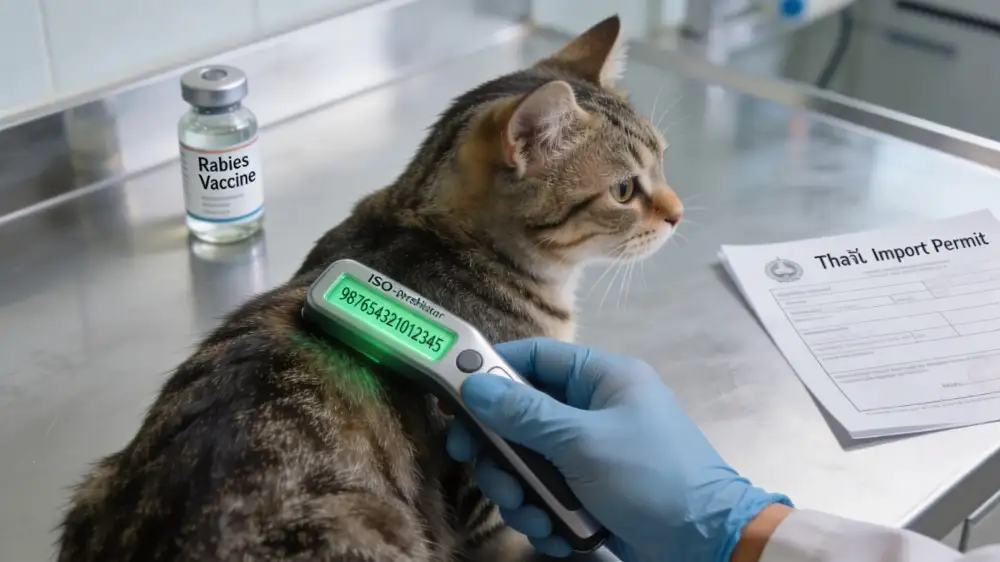
Microchip Comes First, Always: Your pet’s ISO 11784/11785-compliant microchip (15-digit) must be implanted and confirmed by a vet before any vaccinations are recorded. The sequence matters legally. If the chip is inserted after the jab, that vaccination will not be recognised.
The Vaccination Window: Rabies and all core vaccines must be administered no sooner than 21 days and no later than 12 months prior to entry. This window catches people out more than any other requirement, so double-check the dates on every certificate.
The Titre Test Nuance: Thailand itself does not currently mandate a rabies antibody titre test for pets arriving from most countries. However, if you are an expat planning to return to the UK, the EU, or Australia at any point, getting that titre test done before you leave home is one of the smartest moves you can make. It can save you months of waiting when it is time to go back.
Financial Reality Check: Budget between 4,000 and 12,000 THB (~£90 to £270 GBP / $110 to $330 USD) for comprehensive blood work, certificates, and official processing. Agent-assisted applications add a further 3,000 to 7,000 THB (~£68 to £158 / $83 to $193 USD) but save enormous amounts of stress.

Lock in your Thailand accommodation
early and beat peak-season price hikes.
Agoda’s filters let you compare options
side by side before you commit.
Why This Paperwork Matters More Than You Think

Thailand is not a rabies-free country. That fact sits at the heart of every bureaucratic requirement on this list, and understanding it reframes the whole process. The Department of Livestock Development (DLD) is not making your life difficult for sport. It is protecting a domestic animal population, a tourism economy, and millions of people who interact with animals every single day. When you see it that way, the paperwork stops feeling like an obstacle and starts feeling like something you are genuinely glad exists.
For expats relocating from the UK, this process will feel familiar in spirit, even if the paperwork trail looks different. The Animal and Plant Health Agency (APHA) in Britain operates on similar logic: microchip, vaccinate, wait, certify. The Thai system mirrors that sequence closely enough that anyone who has moved a pet within Europe will find their footing quickly. The key difference is the import permit requirement, which is unique to Thailand and requires its own dedicated application process through the DLD portal.
If you are moving your family, your dog, and your two cats to a long-term base in Chiang Mai or a beachside villa in Hua Hin, the investment in getting this right is trivial compared to the cost of a 30-day government quarantine stay. That scenario is very real, and it is entirely avoidable with a bit of disciplined organisation six months before your departure date.

Skip-the-line tickets and guided walks
in Thailand with English-speaking
guides. Read real traveller reviews
before committing to a single one.
Understanding the Titre Test: Your Return Ticket Home
The Rabies Antibody Titration Test (FAVN) measures the concentration of neutralising antibodies in your pet’s blood following vaccination. A passing result requires a minimum of 0.5 IU/mL. The test cannot be done in isolation: the pet must already be microchipped and vaccinated before the blood draw, and the serum sample must be sent to an OIE-approved laboratory for analysis. In the UK, the most commonly used approved lab is the Animal and Plant Health Agency’s own facility in Weybridge.
Here is why this is so tactically important for British expats specifically. The UK’s pet travel rules require that any pet arriving from a non-listed country (which Thailand is) must have a valid titre test result of 0.5 IU/mL or above before being eligible to enter. If that titre test was not performed before you left the UK, or is not performed a full three months before you plan to return, your pet cannot enter the UK without going into a government-approved quarantine facility at your expense.
The solution is beautifully simple: get the titre test done in the UK before you fly to Thailand. If your pet passes (the vast majority of healthy, properly vaccinated animals do), that result is valid for re-entry to the UK as long as your pet’s rabies vaccinations remain current. It is a one-time administrative act that gives you unlimited flexibility for years. For expats on the Destination Thailand Visa (DTV) who may need to return home for family emergencies, business commitments, or simply a change of heart, this test is not optional. It is essential insurance.
Blood Work and Testing: Full Cost Comparison
| Requirement | Standard Specification | Typical Cost (THB) | Approx. GBP |
|---|---|---|---|
| Microchip Implant | ISO 11784/11785 (15-digit) | 600 – 1,200 | ~£14 – £27 |
| Rabies Titre Test (FAVN) | ≥ 0.5 IU/mL Result | 6,500 – 15,000 | ~£148 – £340 |
| Core Vaccinations (Cats) | RCP + Rabies | 800 – 2,500 | ~£18 – £57 |
| Core Vaccinations (Dogs) | DHLPP + Rabies | 800 – 2,500 | ~£18 – £57 |
| Health Certificate (Vet) | Licensed Vet + Official Stamp | 1,000 – 3,000 | ~£23 – £68 |
| DLD Import Permit (Official) | DLD Portal Application | Free – 500 | ~Free – £11 |
| Agent-Assisted Processing | Full document handling | 3,000 – 7,000 | ~£68 – £158 |
Exchange rates are approximate and based on 1 GBP = approximately 44 THB. Always verify current rates before budgeting.
The Microchip-First Rule: Why Sequence Is Everything
If there is one rule that catches expat pet owners completely off guard, it is the microchip-first sequence. It sounds straightforward until you realise that a surprising number of UK vets will chip and vaccinate on the same visit without confirming the recorded order of events in the paperwork. For domestic UK travel, this makes no difference whatsoever. For international relocation to Thailand, it can invalidate the entire vaccination record.
The ISO 11784/11785 standard requires a 15-digit identification chip, which is the same standard used across Europe. If your pet was chipped in the UK as a puppy or kitten, there is a very good chance it already meets this requirement. The crucial step is verifying that the chip number recorded in the vaccination booklet and on the health certificate matches exactly what the scanner reads. A single transposed digit is enough to cause a lengthy hold at the Animal Quarantine Station (AQS).
When you visit your vet for the pre-travel health check, explicitly ask them to scan the chip first, read the number aloud, and confirm it against all documentation before proceeding. This takes approximately 30 seconds and eliminates one of the most common causes of airport delays. Bring a printed copy of your pet’s registration documents and match them on the spot.

Pick a Thailand eSIM plan that matches
your trip length on Airalo’s global
marketplace. Install before departure
and you’re online the moment you land.
Mandatory Vaccinations: The Biological Gateway
Thailand requires that all dogs and cats entering the country are vaccinated against rabies, with the injection given no fewer than 21 days before arrival. Beyond rabies, dogs must also be protected against Leptospirosis, Distemper, Hepatitis, and Parvovirus. Cats must be immunised against Feline Panleukopenia Virus. Every vaccination record submitted to the DLD must clearly display the vaccine batch number, the manufacturer’s name, and the product’s expiry date. Incomplete records are rejected.
For UK-based expats, your vet’s official passport or health certificate booklet will carry most of this information automatically. The issue arises when records are handwritten in a format that differs from the DLD’s expectations. If your vet uses a digital records system, request a printed summary on headed paper with an official stamp. Thai customs officers are accustomed to international paperwork, but clarity and completeness are what earn you a swift wave-through rather than a drawn-out inspection.
The AQS at Suvarnabhumi Airport (BKK) processes the majority of incoming pets for Bangkok. Officers there work efficiently, but the experience can feel clinical and a little intimidating when you are sleep-deprived from a long-haul flight with a stressed animal in tow. Presenting your documents in a clearly labelled folder, ordered logically (permit on top, then health certificate, then vaccination record, then titre test if applicable), will make the encounter faster and calmer for everyone involved. A warm greeting in Thai goes a long way: “Sawasdee krap” (male speaker) or “Sawasdee ka” (female speaker) signals respect and tends to soften the bureaucratic atmosphere considerably.
The DLD Import Permit: Applying Before You Book Your Flights
The import permit issued by Thailand’s Department of Livestock Development is the single most important document in your pet relocation file. Without it, your animal will not be allowed to enter the country, regardless of how immaculate the rest of your paperwork is. Applications must be submitted at least 15 business days before arrival, but experienced expats and pet relocation agents recommend allowing 30 days to account for any requests for additional information or corrections.
The application is submitted through the DLD’s online portal and requires your pet’s microchip number, vaccination records, a copy of your own passport, and your intended arrival date and airport. The permit is tied to a specific entry point: a permit issued for Suvarnabhumi is not valid for Don Mueang, and vice versa. If your travel plans change and you switch airports, contact the DLD immediately to amend the permit before your flight.
The permit itself carries either no fee or a nominal processing charge of around 500 THB (~£11). If you find the portal confusing or your Thai language skills are not up to navigating a government website, a licensed pet relocation agent is a worthwhile investment. Reputable agencies typically charge between 3,000 and 7,000 THB (~£68 to £158) for the full administrative package. They handle permit applications, coordinate with the AQS, and often provide a point of contact at the airport during inspection. For families moving with multiple pets or those arriving with larger breeds, this service pays for itself in peace of mind alone.
When managing your DLD portal applications, use NordVPN if you experience connectivity issues on foreign networks. Government portals in Thailand can occasionally be temperamental when accessed from outside the country, and a VPN routed through a Thai or regional server can resolve access problems quickly without the need to wait for a local connection.

Saily’s Thailand eSIM costs less than
most tourist SIMs charge per day.
Easy install, transparent pricing,
and solid NordVPN infrastructure.
Choosing the Right Airline: Pets in Cabin vs. Cargo Hold
The question of whether your pet travels in the cabin or in the hold depends almost entirely on the airline, not Thai law. Thailand’s entry requirements apply equally regardless of where your animal sat during the flight. What varies is the stress level for your pet and the logistics of collection at the other end.
For UK-based travellers, the most common long-haul routes to Bangkok are operated by carriers including British Airways, Thai Airways, and connecting flights via Gulf carriers such as Emirates, Qatar Airways, and Etihad. Most of these airlines do not permit pets in the cabin on long-haul routes. Smaller dogs and cats may travel as excess baggage in a temperature-controlled hold compartment, while larger breeds are typically shipped as manifest cargo through a separate freight process. This is worth researching thoroughly before you book, as cargo shipping involves separate booking processes, different check-in terminals, and collection at a different point on arrival.
If your flight is disrupted, delayed significantly, or cancelled, an animal in the hold or cargo system becomes a considerably more complicated situation than a delayed piece of luggage. AirHelp covers passengers on eligible EU and UK regulated routes for compensation on delays of three hours or more. While compensation does not resolve the stress of a delayed pet arrival, it can offset costs associated with extended airport accommodation or rebooking fees.
Book airport transfers in advance rather than relying on finding a taxi at the kerb. Welcome Pickups offers pre-booked, fixed-price private transfers from Suvarnabhumi that are particularly suitable for families arriving with pet crates, multiple bags, and the general chaos of an international move. Having a confirmed driver waiting with your name on a board, with the boot space already accounted for, removes one major variable from what is already a complex arrival day.

From temples to island tours, Klook
covers Thailand’s best experiences.
Hotel pickup is often included and
prices beat the pier walk-in rate.
Your Six-Month Pre-Departure Timeline
Six Months Before Departure: Schedule your vet appointment to confirm microchip compliance. If your pet is not yet vaccinated or boosters are due, get these done now. Request the titre test (FAVN) blood draw and dispatch to an OIE-approved lab. If the result comes back below 0.5 IU/mL, a booster vaccination is required followed by a three-month wait before retesting. Starting six months out gives you the buffer to handle this without panic.
Three Months Before Departure: Confirm your titre test result has been received and filed. Begin researching approved pet relocation agents or start your DLD import permit application independently. Book your flights and confirm the airline’s specific pet policy for your route, paying close attention to crate dimension requirements and weight limits.
One Month Before Departure: Submit your DLD import permit application if not already done. Begin sourcing IATA-compliant travel crates if you do not already own one. Arrange your pet’s final health check and official health certificate, which must typically be issued within 10 days of travel by a government-accredited vet. Book long-stay accommodation via Agoda or Booking.com using the dedicated pet-friendly filter: this is critical in Bangkok and Chiang Mai, where many otherwise excellent apartments and condos have strict no-pet policies.
One Week Before Departure: Confirm all documents are complete and printed in duplicate. Arrange your eSIM through Airalo, Yesim, or Saily and activate it before you board. The AQS clearance process at Suvarnabhumi may require you to receive SMS verification codes from the DLD or your relocation agent while standing in the arrivals hall, and roaming charges or SIM activation delays can create unnecessary complications at exactly the wrong moment. Having a working Thai data number before you land is not optional.
The Destination Thailand Visa: The Right Foundation for Long-Term Pet Owners
The Destination Thailand Visa (DTV) offers five years of multiple-entry access with up to 180 days per entry, and it has become the primary visa vehicle for remote workers, freelancers, and expat families making a serious commitment to life in Thailand. For pet owners, the DTV represents something beyond just a visa: it represents the stability needed to settle into a permanent home, find a trusted local vet, and build the kind of routine that animals thrive in.
The financial requirement for the DTV sits at 500,000 THB (~£11,350) in accessible savings, which must be demonstrated at the time of application. This is not a fee paid to the Thai government: it is proof that you have the means to sustain your stay without becoming reliant on local services. For families who are simultaneously funding a UK property exit, school transitions, and international shipping costs, this figure is worth confirming well in advance.
The DTV is a genuine upgrade from the old culture of 90-day tourist visa runs that many long-term Thailand residents used to manage. Those runs were disruptive at the best of times, but for pet owners they created a recurring logistical nightmare: what do you do with your animals every three months when you need to cross a border? The DTV eliminates that problem entirely, allowing you to focus on building a life rather than managing an exit strategy.
For health and medical security during your long-term stay, SafetyWing offers international nomad insurance that covers emergency medical treatment across Thailand and includes repatriation provisions. For expats in their 30s and 40s managing young families alongside their pets, having a clear medical insurance structure in place from day one is one fewer thing to worry about while the rest of the relocation settles in.
Finding Pet-Friendly Accommodation in Thailand

Finding genuinely pet-friendly long-term accommodation in Thailand requires more diligence than a standard holiday booking. The “pet friendly” filter on Agoda and Booking.com is a useful starting point, but many listings use the label loosely. Always message the property directly before confirming your booking to ask specifically about breed restrictions, deposit requirements, and whether outdoor access (a balcony, garden, or communal green space) is available.
In Bangkok, the neighbourhoods of On Nut, Phra Khanong, and Ekkamai have developed genuinely welcoming pet communities over the past several years. You will find dedicated dog parks, pet-friendly cafes, and an increasing number of condo buildings that have moved away from blanket no-pet policies. Sukhumvit’s mid-range serviced apartments are a particularly good option for the first month of arrival: they offer flexible lease terms, are set up for immediate habitation, and give you time to search for a longer-term rental at your own pace.
In Chiang Mai, the Nimman and Santitham areas host a dense concentration of expat-friendly housing with garden access, a factor that becomes significantly more important when you are managing a dog through the adjustment period of a new country. Hua Hin and Koh Samui offer the most generous pet policies of any accommodation market in Thailand, with many villa rentals explicitly marketed to pet owners and including fenced outdoor space as standard.
For intercity travel once you are settled in Thailand, 12GO is the most reliable platform for booking buses, trains, and ferry tickets in advance. If you are relocating from Bangkok to Chiang Mai or heading to the coast with your animals, locking in tickets and transport options through 12GO before public holidays (particularly Songkran in April) will save you from the chaos of sold-out national travel windows.
Veterinary Care in Thailand: Better Than You Expect
Thailand’s veterinary sector in its major cities is genuinely world-class and, for UK expats accustomed to RCVS-standard care and NHS pricing at the pharmacy, it is a pleasant surprise on both quality and cost. Clinics in Bangkok operate with high-specification diagnostic equipment, bilingual staff, and a standard of cleanliness that rivals private practices in London or Edinburgh. Consultation fees at a premium Bangkok clinic typically run between 500 and 1,500 THB (~£11 to £34), which compares very favourably to UK vet prices.
Recommended clinic clusters exist in several Bangkok districts. The Thonglor and Ekamai areas host some of the city’s most established international veterinary practices, several of which maintain English-language client portals and offer appointment booking via LINE, the dominant messaging app in Thailand. In Chiang Mai, a growing number of expat-focused clinics have opened along the Nimmanhaemin Road corridor, and many offer annual wellness packages specifically designed for long-stay residents.
One thing to note about pricing at private clinics: you will frequently see “++” listed on your invoice. This refers to the 7% Value Added Tax and the 10% service charge applied at full-service private hospitals. Always factor an additional 17% on top of any quoted treatment price at premium facilities. Budget clinics and government veterinary services do not typically apply this surcharge. Carry Thai Baht (THB) in cash for smaller clinics, as international card machines are not universal across the country.
For internal Bangkok travel to and from vet appointments, the Grab app (specifically the GrabPet option) is the most reliable way to ensure your driver is prepared for an animal passenger. Bolt is a strong alternative for longer trips to areas like Bang Na, typically at a lower price point than Grab. Both apps require a working mobile data connection to process bookings: activate your Airalo, Yesim, or Saily eSIM before landing so you have immediate connectivity at the baggage carousel.
Keeping Your Pets Healthy in a Tropical Climate
Moving a pet from the UK’s temperate climate to tropical Southeast Asia involves a genuine physiological adjustment period that most relocation guides underplay. The combination of high heat, humidity, and a completely different ecosystem of parasites, insects, and environmental bacteria creates health challenges that require proactive management from the moment your animal arrives.
Heartworm is transmitted by mosquitoes and is endemic in Thailand. If your dog is not already on a monthly heartworm preventative, begin this before departure and continue it without interruption throughout your stay. Your UK vet can prescribe a suitable preventative medication and your Bangkok vet will be able to continue the prescription on arrival. Annual heartworm testing is recommended even on continuous preventative protocols.
Tick-borne diseases, including ehrlichiosis and babesiosis, are also present in Thailand and can be severe in dogs. Monthly tick prevention (spot-on treatments or tick collars) is essential. Leptospirosis, which dogs must be vaccinated against as part of the Thai entry requirements, is a genuine risk in tropical environments, particularly near waterways, flood-prone areas, and anywhere rats may be present. Ensure your dog’s Lepto vaccination is kept current throughout your stay in Thailand.
For cats, the adjustment is often more about thermal comfort and environmental enrichment than disease risk. Indoor cats adapt reasonably well, though the heat can cause lethargy in animals accustomed to cool British temperatures. Ensure constant access to fresh water, air-conditioned resting spaces, and environmental stimulation during the first weeks of adjustment. Many Bangkok expat cats settle into a pleasantly slower pace of life that their British habits never quite allowed for.
Pro Tips for Stress-Free Travel With Pets
Transport: Use the Grab app and select “GrabPet” for dedicated pet-friendly transport in Bangkok. Bolt is often more budget-friendly for longer trips to outskirts like Bang Na. Both require an active mobile data connection, so activate your Airalo, Yesim, or Saily eSIM before you land to handle SMS verification codes at the baggage carousel without delay.
Accommodation: Agoda and Booking.com both offer dedicated “Pet Friendly” filters. In regions like Hua Hin and Koh Samui, pet-friendly villa options are particularly plentiful. Always confirm directly with the property before booking to verify breed restrictions and deposit requirements.
Logistics and Excursions: Klook and Get Your Guide offer private transfers from Suvarnabhumi (BKK) that can often accommodate pet crates if you message the provider in advance. For day trips and activities once settled, both platforms are excellent for booking cooking classes, temple tours, and island excursions in a way that fits around your pet care routine.
Intercity Travel: Use 12GO to book buses, trains, and ferries in advance, particularly around Songkran (April) and other national holiday periods when transport sells out rapidly.
Connectivity: Activate an eSIM through Airalo, Yesim, or Saily before departure. You will need a working Thai number to receive communications from the AQS during the clearance process, and to operate booking apps from the moment you arrive.
Digital Security: Use NordVPN to manage DLD import permit applications and other official portal access from outside Thailand. Government portals can behave erratically on foreign network connections, and a regional VPN server resolves most access issues immediately.
Medical Cover: SafetyWing provides flexible international nomad insurance that covers Thailand and is available to UK citizens. For expats managing family health alongside their relocation, having a clear insurance structure in place before arrival removes a significant layer of financial uncertainty.
Currency: Always carry THB cash for small and mid-range vet clinics, pet supply shops, and the “Plus Plus” VAT and service charges at private facilities. International cards are not universally accepted outside major urban centres and tourist areas.


Stay online in Thailand without the
daily data limits of tourist SIMs.
Yesim’s eSIM offers unlimited 5G
from around $10 for the whole trip.
A Note for the Nervous Expat: You Can Do This
It is entirely natural to feel overwhelmed by this process. Navigating foreign bureaucracy is stressful at the best of times, and doing it while also managing a house move, a career transition, and the emotional weight of uprooting your family adds layers of complexity that no checklist fully captures. But here is the truth, based on the experience of thousands of expats who have done exactly this: Thailand’s pet import system is one of the more logical and predictable in Southeast Asia, and it rewards preparation generously.
The veterinary community in Bangkok and Chiang Mai is genuinely excellent. Many clinics have international vets on staff, English-language customer service as standard, and a level of professional warmth that makes follow-up appointments a pleasure rather than an ordeal. The expat pet owner community in Thailand is also extraordinarily well-connected: Facebook groups for expats in Bangkok, Chiang Mai, and Hua Hin contain hundreds of threads from people who have navigated this exact process and are happy to share their experience in real time.
You are not pioneering this. Thousands of families have brought their dogs, cats, and the occasional rabbit to Thailand and have found that the effort was repaid many times over in the quality of life that followed. The paperwork is a door, not a wall. Get the sequence right, start early, and on the other side of that arrival hall, your pets will be basking in the warmth of something that feels a lot like the life you always meant to be living.
Frequently Asked Questions
Do I need a rabies titre test to bring my pet to Thailand from the UK?
Thailand does not currently require a titre test for pets arriving from most countries, including the UK. The mandatory requirements are a valid ISO-compliant microchip, a rabies vaccination certificate dated at least 21 days before arrival, core vaccinations appropriate to your pet’s species, and a DLD-issued import permit. However, the titre test (FAVN, minimum 0.5 IU/mL) is strongly recommended for any UK-based expat who may wish to return to Britain with their pet. Without a valid titre test on record, pets returning to the UK from Thailand (a non-listed country) may face a mandatory quarantine period at a government-approved facility at the owner’s expense.
How much does the Thai pet import permit cost and how do I apply?
The DLD import permit is officially free or carries a nominal processing fee of approximately 500 THB (~£11). Applications are submitted through the Department of Livestock Development’s online portal and require your pet’s microchip number, vaccination records, a copy of your passport, and your confirmed arrival date and airport. Allow at least 15 business days, though 30 days is a safer buffer. Many expats use licensed pet relocation agents who charge between 3,000 and 7,000 THB (~£68 to £158) for full document handling, which is worthwhile for those relocating with multiple animals or complex documentation.
Can I fly my pet in the cabin on a long-haul flight from the UK to Bangkok?
Most long-haul carriers operating UK to Bangkok routes do not permit pets in the cabin. Small dogs and cats typically travel as excess baggage in a temperature-controlled hold compartment, while larger breeds are shipped as manifest cargo through a separate freight process. Policies vary significantly by airline, so confirm directly with your carrier before booking. European carriers such as Lufthansa or KLM may offer cabin options on connecting European legs, but not on the long-haul segment. Always check whether your specific route and aircraft type permits pet travel, as this can vary even within the same airline.
What is the ‘Plus Plus’ charge I keep seeing at Thai vet clinics?
The ‘++’ notation on invoices at private Thai veterinary hospitals refers to two separate surcharges applied on top of the base treatment price: a 7% Value Added Tax (VAT) and a 10% service charge. Together these add 17% to your bill, which can be a surprise if you are not expecting it. Budget clinics and government veterinary services do not typically apply this surcharge. Always ask for a breakdown before authorising treatment at a premium clinic, and carry Thai Baht cash as international card terminals are not universally available at smaller practices.
What happens if my pet’s paperwork is rejected at Suvarnabhumi Airport?
If there is a minor clerical error on your documentation, the Animal Quarantine Station (AQS) may allow a 48-hour window for the error to be corrected before a final decision is made. If core vaccination records are missing or the import permit is invalid, the pet may be transferred to the Bang Na quarantine centre for a mandatory 30-day stay at the owner’s expense, which can cost several thousand THB per day. If the pet cannot be cleared at all, repatriation to the country of origin becomes the only remaining option. This scenario is entirely avoidable with correct preparation, which is why starting the process six months before departure is consistently recommended.
How long is the titre test result valid for re-entry to the UK?
A successful FAVN titre test result (0.5 IU/mL or above) does not expire in isolation, but it must be supported by a continuously maintained rabies vaccination record. In practice, this means your pet’s rabies vaccinations must be kept current without any lapse. If a booster is missed and the vaccination is considered out of date, the titre test result loses its validity for UK re-entry purposes and a new test must be conducted, followed by a three-month waiting period before the pet can enter the UK. This is why expats on long-term stays in Thailand should track vaccination booster dates carefully and never allow a gap in coverage.
Are there breed-specific restrictions for bringing dogs into Thailand?
Thailand does not currently maintain a comprehensive list of banned breeds at the national level equivalent to the UK’s Dangerous Dogs Act, but individual airlines and accommodation providers may impose their own restrictions. Certain breeds, including American Pit Bull Terriers and their crosses, may face additional scrutiny or refusal at the airline booking stage. Always confirm your specific breed’s eligibility with your airline before purchase. Once in Thailand, condo buildings and rental properties in Bangkok frequently impose size and breed restrictions independently of national law, so screen accommodation listings carefully and always confirm pet policy in writing before committing to a lease.
Do cats need the same paperwork as dogs when entering Thailand?
The core documentation requirements are the same for both cats and dogs: ISO-compliant microchip, rabies vaccination certificate (administered at least 21 days before arrival), and a DLD import permit. The primary difference lies in the required vaccinations beyond rabies. Dogs must be vaccinated against Distemper, Hepatitis, Leptospirosis, and Parvovirus (DHLPP). Cats must be vaccinated against Feline Panleukopenia Virus (part of the RCP or FVRCP combination vaccine). Both species require a health certificate issued by a licensed, government-accredited veterinarian, and all records must include vaccine batch numbers, manufacturer details, and expiry dates.
Can I bring my pet to Thailand on a tourist visa, or do I need a long-stay visa?
Your visa type has no direct bearing on Thailand’s pet import requirements. Pets can legally enter Thailand with owners on any valid visa category, including tourist visas. However, the practical logistics of international pet relocation, including finding stable long-term accommodation, establishing a relationship with a local vet, and managing re-vaccination schedules, make the Destination Thailand Visa (DTV) a far more sensible choice for anyone bringing animals into the country. The DTV’s 180-day stays per entry and five-year validity eliminate the disruption of frequent border crossings and provide the residential stability that pets require to settle and thrive.
What should I do if my pet becomes seriously ill while living in Thailand?
Major Thai cities have excellent veterinary emergency facilities, with Bangkok in particular hosting several 24-hour animal hospitals in the Thonglor, Ekkamai, and Lat Phrao areas. In a genuine emergency, call ahead to confirm the clinic’s after-hours capabilities before transporting your animal. For routine illness and follow-up care, clinics in the Nimman Road area of Chiang Mai and along Sukhumvit in Bangkok are well-regarded by the expat community. Maintain a digital copy of all your pet’s medical records, vaccination certificates, and microchip documentation in cloud storage so that any Thai vet can access your pet’s full health history without delay. Having SafetyWing international medical insurance for yourself also ensures that a pet emergency does not coincide with a financial crisis for the family managing it.